
18 placements, 500+ Disavowed Toxic Links: Off-Page SEO for a Law Firm
Project Goal
The existing backlink profile was the real risk: dozens of irrelevant, and in some cases toxic, links from questionable link networks that did not align with either the subject matter or the quality standards of a law firm. Rather than strengthening authority, they actually undermined it—a risk that had to be eliminated before continuing to work on improvements.
Therefore, the project’s objective was divided into two parts: first, to clean up the backlink profile; then, to specifically generate new, appropriate topical visibility through off-page SEO, precisely where there was a real gap. This was not only for traditional Google searches but, increasingly, also for AI visibility—that is, to determine whether AI systems even mention a law firm in response to a query.
Challenge
The biggest challenge was the baggage from the past: a backlink profile, riddled with links from anonymous link networks and online marketplaces, with no professional connection to the law firm. Not only did these links fail to help, but they also posed an active risk to search rankings and trust—a risk that had to be neutralized before we could even begin to think about building anything.
Added to this was a lack of content: although the law firm was visible for many general terms, it was barely visible for the combination of a specific area of law and a specific location—precisely the searches that matter most when it comes to attracting clients. And one factor that is often underestimated in traditional SEO: visibility increasingly depends on visibility to AI as well.
Project Details
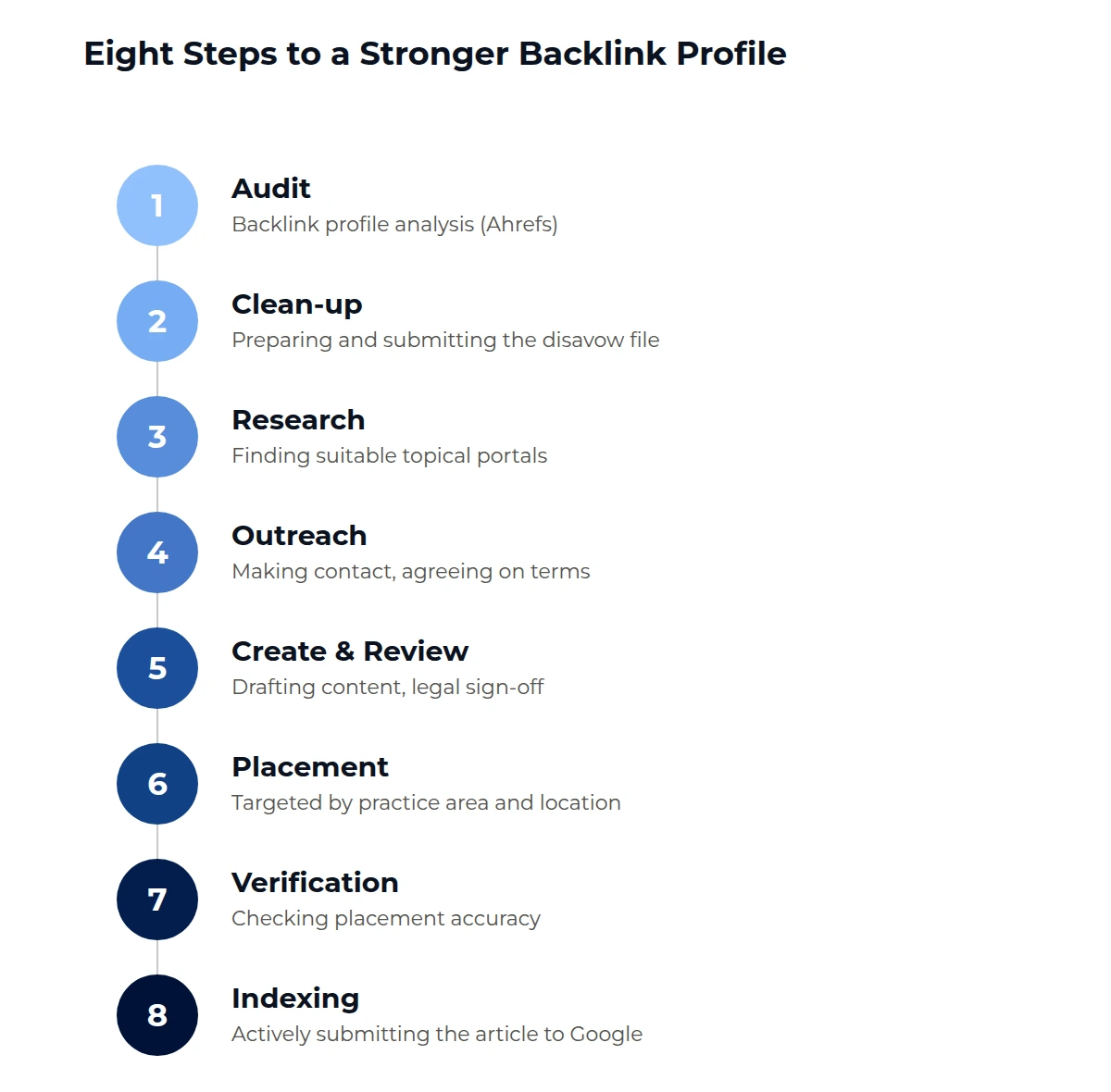
The first step was to conduct a comprehensive backlink audit using Ahrefs to evaluate the existing backlink profile and identify toxic links. The affected links were compiled into a disavow file and submitted via Google Search Console, laying the groundwork for all subsequent steps in the law firm’s off-page SEO strategy. At the same time, a search for suitable niche websites was conducted: through in-house research, reverse engineering the backlink profiles of relevant competitors, as well as leveraging existing contacts and the firm’s own network to reach out directly to editorial teams.
Each content placement was deliberately assigned to a suitable combination of legal practice area and location—rather than creating links at random—so that the new visibility would also make sense from a thematic perspective.
Each article was carefully crafted and, prior to publication, reviewed by the law firm itself to ensure that the content met both legal accuracy and other requirements. The goal was not only traditional visibility on Google, but also the firm’s visibility in AI: a consistent, thematically anchored presence of the law firm across various reliable sources.
Results
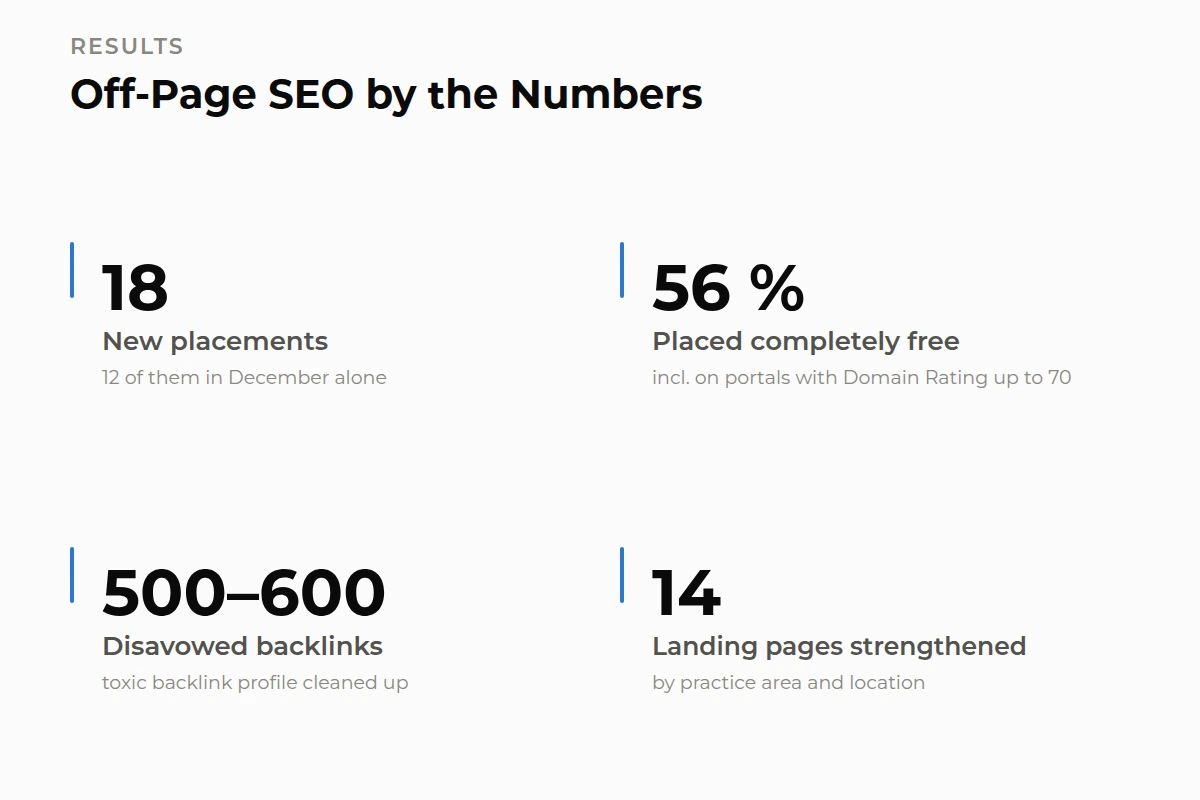
The result after filtering and selective optimization: 18 mentions, twelve of which were in December alone. More than half—56%—were achieved completely free of charge, some even on websites with a Domain Rating of up to 70. This is not the result of an advertising budget, but rather of research, outreach, and negotiation.
Added to this are between 500 and 600 devalued links from the refined backlink profile and 14 selectively strengthened landing pages, chosen from a matrix of legal specialties and locations with 49 possible combinations. Since then, Google Search Console has shown increased visibility specifically for search terms related to legal specialties that were previously barely covered.
And each of these rankings also serves as an additional signal for the law firm’s AI visibility, an effect that goes beyond traditional rankings.